

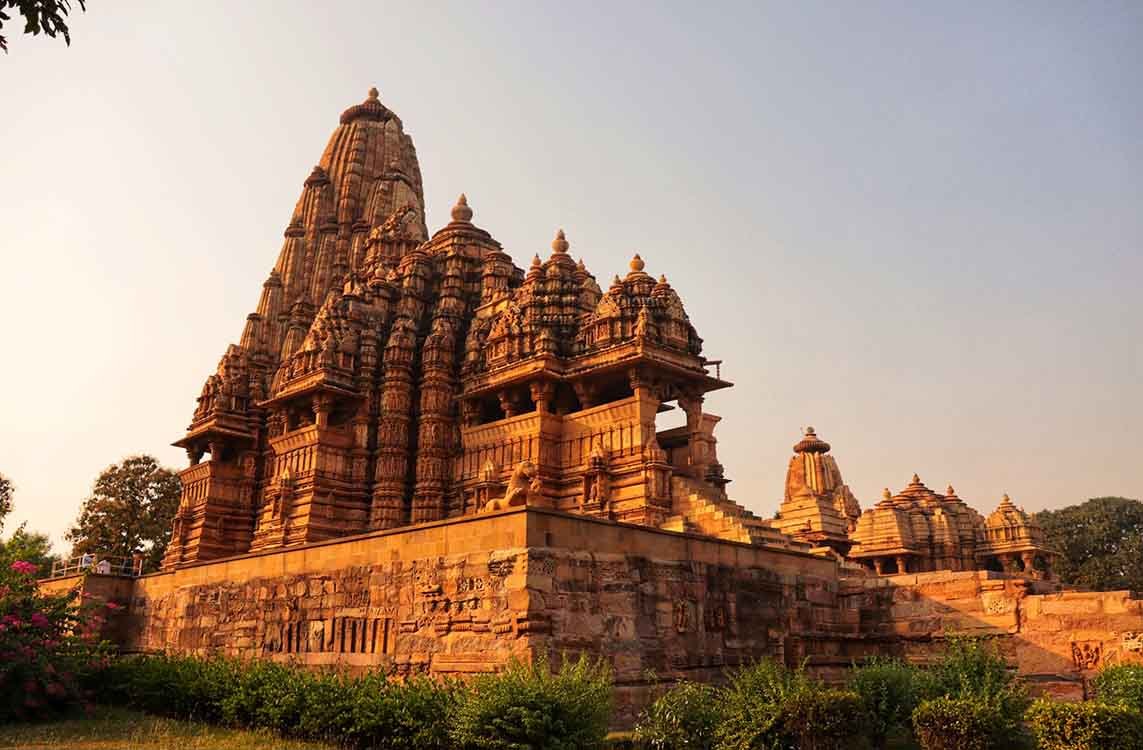
Everyone who picks up his pen to write something on the history of Khajuraho, starts with a conjectural presumption that Khajuraho was once capital of Bundelkhand, where Chandelas ruled around 9th to 13th century AD; and, also to whom building the temples there are attributed.
Only one reason, besides many others mentioned below, is sufficient to counter this fictitious claim: had Khajuraho been the capital city of Chandelas and as such of Bundelkhand, ample traces of forts and palaces, at least their ruins must have been found there. All evidence shows that Chandelas ruled Bundelkhand during the said period from Kalinger in the first instance and then from Ajaigarh. Hence the contention that Khajuraho was the capital of Bundelkhand is totally wrong.
Till 922 AD (Samvat 316) Khajuraho or Jejamukti, as it was called then, was under the rule of Kannauj, as is evident from the inscription engraved on the foundation stone of the idol of Hanuman inside Hanuman temple. When Subuktageen of Ghazni attacked India, Dhanga, father of famous Ganda Chandela was assistant of Jaipal, then king of Punjab. This proves that in its earlier days Chandel dynasty was not even independent, what to say of being rulers of Bundelkhand.
In the recorded history, the first mention of Khajuraho and its temples is found in a travel-book written by Hiuen Tsang, the famous Chinese traveler who visited and remained in India during 629 to 645 AD. He not only visited but stayed at Khajuraho and had given ample description of the place, mentioning large number of temples there attributed to different religions (Bodh, Jains and others), who according to him, were on continuous confrontational course and relationships among themselves; and, the means of approach from one temple to the other was by boat because of presence of a big lake.
Huen Sang’s version also proves that at the time of his visit to Khajuraho temples were in existence, much much before Chandelas came into picture as rulers. Vincent Smith, the noted historian, had also given reasons on the basis of Hiuen Tsang’s descriptions that at the time of his visit, the capital under which Khajuraho was situated was Airon, a place near the ocean.
Additionally, few following facts also confirm that Khajuraho had never been capital of Bundelkhand, ruled by Chandelas:
- Abu Rehan who accompanied Mahmood of Ghazni went to Khajuraho with him but he did not mention it as the capital of Bundelkhand, instead he mentioned Kalinger as the capital.
- Kalinger was the capital of Bundelkhand when Mahmood started invading India. It is a well established fact that Chandelas shifted their capital from Kalinger to Ajaigarh when foreign invasions increased in frequency.
- Farishta had written that Anandpal fought Mahmood Ghaznavi in 1009 with the confederacy of rulers of Kalinger, Gwalior, Ujjain and Kannauj; not with ruler of Khajuraho.
- In 1018 Trilochanpal joined hands with Ganda Chandela to re-conquer Indian territories occupied by Mahmood, when he joined hands with ruler of Bundelkhand, where Ganda ruled from Kalinger. (not from Khajuraho).
- Next time Mahmood returned, he marched in person to Kalinger, the capital of Ganda, son of Dhanga Chandela. On this occasion Ganda fled from Kalinger, but the next time when he came, Ganda presented Mahmood 300 hundred elephants etc and consequently no fighting took place at Kalinger.
- According to Lalitpur inscriptions, in 1181 AD Prithviraj captured Mahoba because Khajuraho had no political significance.
- When Mohd Ghori attacked India in 1202, Parmardeen Chandela was ruling Bundelkhand, capital being Kalinger (not Khajuraho), which was one of the strongest Chandel forts. As Kalinger was occupied, Chandelas moved to Ajaigarh, and Hasan Arnal was appointed by Ghori as governor of this region.
Accordingly above facts, circumstances and records prove beyond doubt that Khajuraho had never been the capital of Bundelkhand. ( Part II would reveal ‘Who actually built Khajuraho temples).